



More Than Energy: How Solar Panels Are Transforming Aquaculture
Share
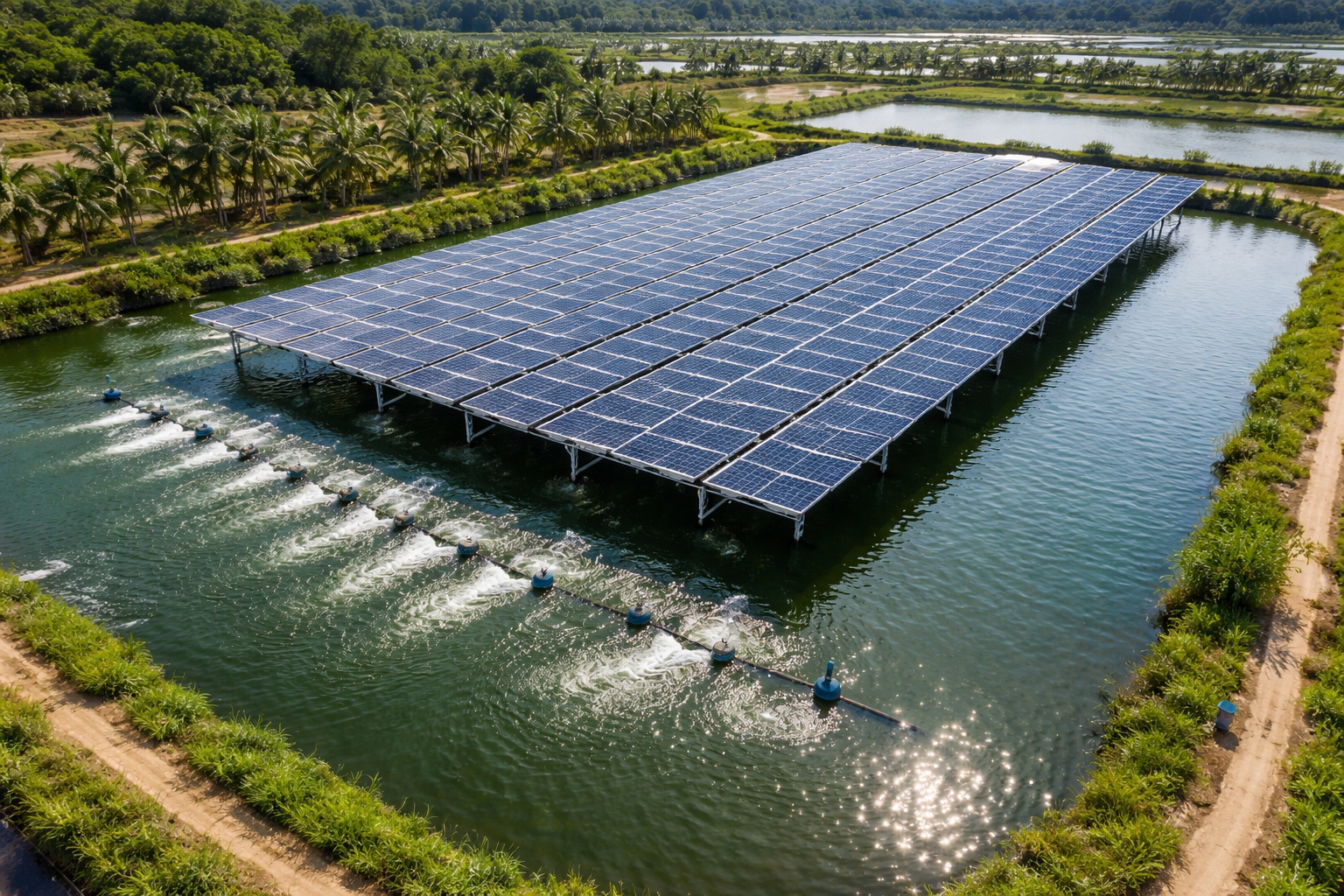
Solar panels are no longer tied exclusively to rooftops or farmland. Exploring new horizons, they are increasingly being seen on terraces, above parking lots, and over sea surfaces, in search of solutions that, beyond producing clean energy, also provide additional benefits. Researchers at Taiwan’s university have shown that solar systems can offer new possibilities even when installed over fish and shellfish ponds.
Climate change, which is felt especially strongly during the summer months, has a pronounced negative impact on aquaculture. More frequent and intense heat waves threaten fish and shellfish, while also making the work of producers who manage these farms more difficult. High temperatures do not only affect aquatic organisms directly; they also accelerate water evaporation from ponds, increasing the need for pumping and raising operational costs.
To explore solutions, scientists conducted a study in which they developed a computer model showing the relationship between weather conditions, water quality, shellfish growth, and solar energy production.
Experiments were carried out under different scenarios—from ponds with no panels at all to cases where up to 70 percent of the pond surface was covered with solar panels. In this context, the panels act as a natural “cooler”: water beneath them remains cooler, reducing heat stress for aquatic organisms. At the same time, the shade decreases water evaporation and allows farms to use their own clean energy to operate the ponds, further reducing costs.
At first glance, it might seem that the shade created by solar panels severely limits conditions in the ponds, but for shellfish, direct and intense sunlight can often be more harmful than partial shading. Certain challenges still exist, however. Phytoplankton—microscopic organisms that form the base of the diet for shellfish and other filter feeders—require sunlight to grow. Too much shade can reduce food availability and slow shellfish growth. The study showed that 40 percent pond coverage by panels can reduce shellfish yields by about a quarter. Still, income from electricity production can offset this loss.
As an optimal solution, the researchers recommend around 45 percent coverage, as this maintains roughly 70 percent of typical shellfish production while maximizing solar energy benefits.
Another advantage of these systems is significant water savings, which are especially important in coastal areas where water supply is often limited or expensive. Reduced evaporation can save up to 30 percent of water, lowering operational costs and increasing resilience during dry periods.
Although the study focused on shellfish cultivation, the same principle can be applied to fish ponds, shrimp farms, and other types of aquaculture, with shading levels adjusted to the needs of different species.
Katarina Vuinac