




Newsletter Subscribe
Enter your email address below and subscribe to our newsletter


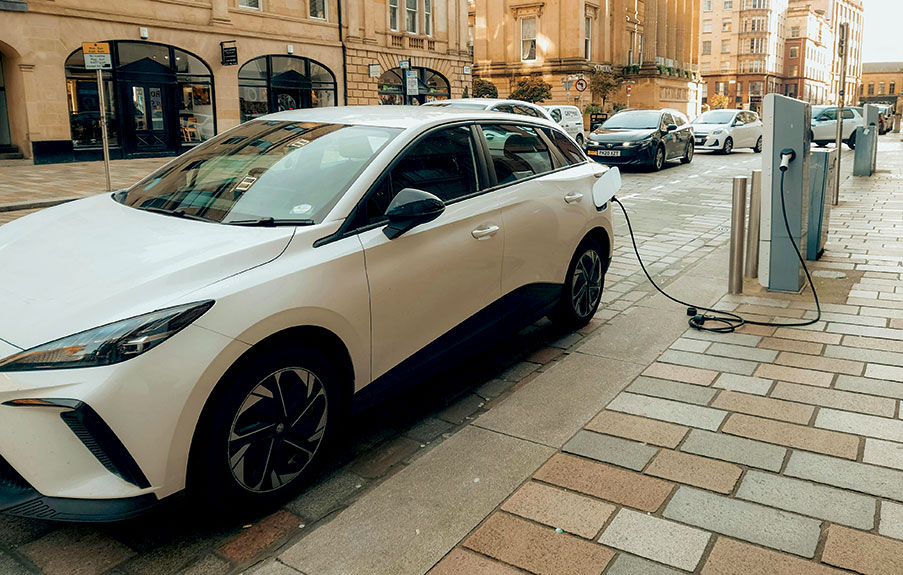
The first wave of electric cars is already slowly transitioning from the category of new technology into the category of used vehicles. As the number of electric cars on the roads grows, the question is increasingly being asked: what happens when a car ages, and its battery can no longer deliver the performance it did when it was new?
The answer is neither simple nor does it necessarily mean that the battery goes straight to recycling.
One of the biggest doubts for potential buyers of used electric cars is the condition of the battery. If the battery loses capacity over time, does that mean the used electric car becomes unusable?
In its 2024 analysis, the company Geotab tracked the condition of batteries in nearly 5,000 electric vehicles. The average battery degradation was 1.8 percent per year. In that analysis, the most successful models had an average degradation of about one percent per year.
An even more extensive analysis, published in early 2026, covered more than 22,700 electric vehicles from various manufacturers and models. The average annual degradation was 2.3 percent. Geotab also determined that degradation is influenced by charging methods, temperature, and the time the battery spends at very high or very low charge levels. Degradation was higher in vehicles that frequently rely on high-power DC fast charging.
This doesn’t mean that every battery will last the same amount of time – cell chemistry, usage patterns, and operating conditions differ from model to model.
Additionally, a battery that has lost some of its original capacity can still be perfectly usable in a car – just with slightly less range. And when it is no longer optimal for the car, that doesn’t necessarily mean its life is over.
An electric car requires a high-performance battery: it must be relatively lightweight, safe, and capable of delivering a large amount of energy in a short time. However, a stationary energy storage system does not require the same conditions.
A battery that is no longer ideal for a car can be used as part of a system that stores electricity generated from solar panels or other renewable sources. It can help balance consumption, store energy for later use, or reduce the load on the electricity grid.
This is precisely why there is increasing talk about “second-life” batteries – batteries that, after their time in a car, get a second life.
Scientific research published in the journal Nature Communications analyzed the potential of combining vehicle-to-grid (V2G) technology and the reuse of electric vehicle batteries. The authors estimated that by 2040, reusing 40 percent of EV batteries for stationary needs could cover a significant portion of the European Union’s energy storage needs, while the broader application of V2G technology could have even greater potential. The model also shows the possibility of reducing the overall demand for primary raw materials.
In other words, one battery could change its role several times: first to power a car, then to store electricity, and only after that to be dismantled and recycled.
Manufacturers are already building infrastructure for ‘life after the car’
The Volkswagen Group launched a pilot battery recycling program in Salzgitter, Germany, back in 2021. What is particularly interesting is that the batteries are first analyzed to determine if they can still be used for other purposes. Only those that are no longer suitable for reuse enter the recycling process. The company cited mobile energy storage systems, including flexible fast-charging stations, as one example of second use.
Mercedes-Benz applies a similar principle. In 2024, the company opened a battery recycling plant in Kuppenheim, Germany. The plant uses a combined mechanical-hydrometallurgical process, with a projected material recovery rate of over 96 percent. Among the materials that can be extracted are lithium, nickel, and cobalt, which can be reused in battery production.
So, instead of a linear model:
mine → battery → car → waste
we get a much longer chain:
raw materials → battery → car → second use → energy storage → recycling → new batteries.
However, second life is not a magic solution
It would be wrong to conclude that every old battery can automatically become a home or grid battery. There are technical, safety, and economic challenges.
Batteries from different manufacturers and models have different chemistries, constructions, management systems, and usage histories. Before they can be used for a new purpose, their condition and remaining capacity need to be assessed.
A particular challenge is precisely the State of Health (SoH) – the assessment of how “healthy” a battery really is. Research into second-life batteries is therefore increasingly focusing on algorithms that can estimate their condition during operation.
Furthermore, if the price of new batteries is low enough, the dismantling, testing, transport, and reassembly of old batteries must make economic sense.
It is clear that not every battery will necessarily go through the same path, and for this reason, the real test of battery circularity will only begin when the first big wave of electric cars ages.
Milena Maglovski