

Newsletter Subscribe
Enter your email address below and subscribe to our newsletter


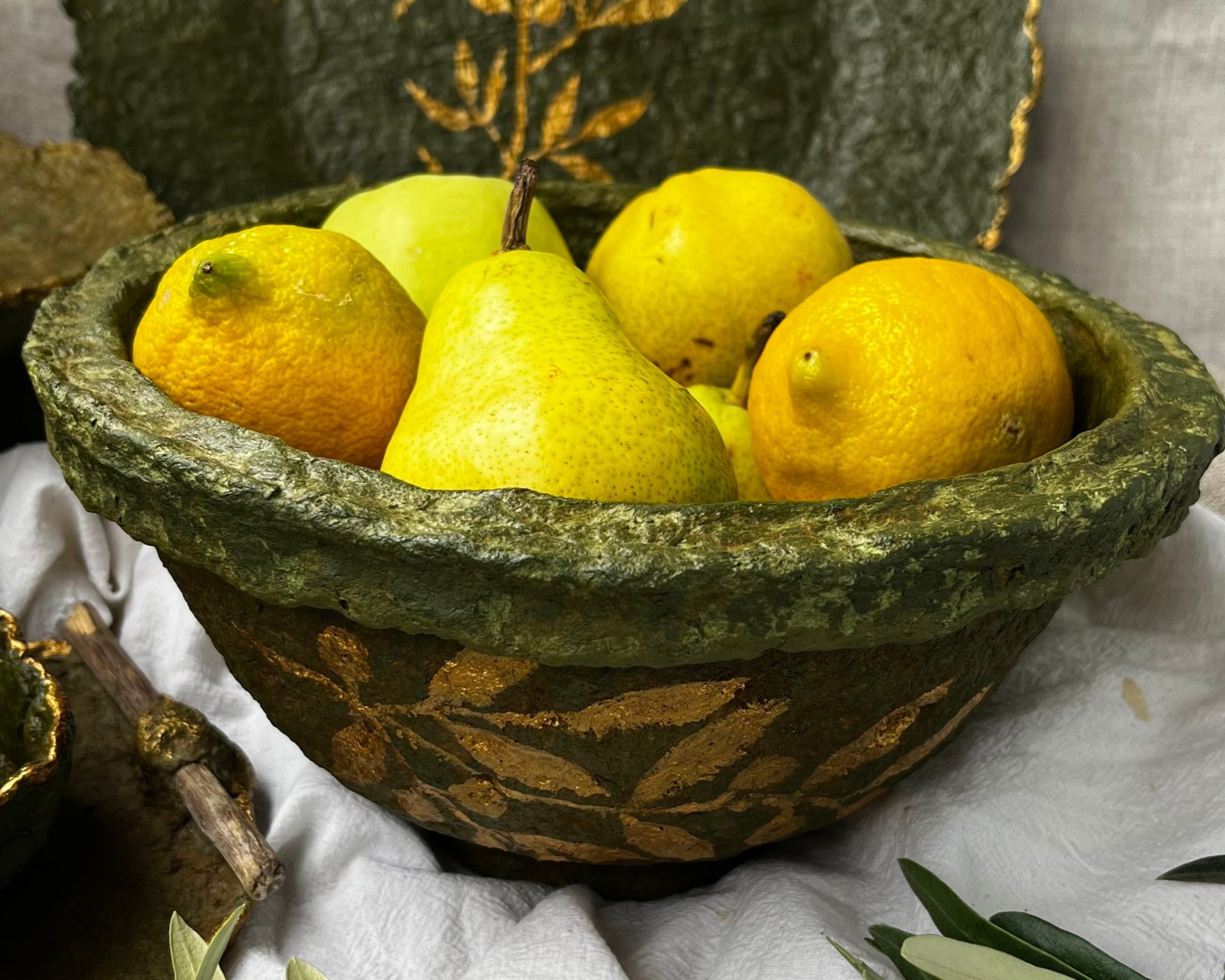
In an age of mass production and objects without a personal touch, there is a growing appreciation for things created with patience, skill, and dedication to handcraft. One such story is woven into the unique objects Mariana Pop creates using the papier-mâché technique. Her life in Podgorica, the city where she now lives and creates, began 25 years ago, after she moved from Ukraine, the country where she was born. As she says, ever since childhood, she has loved imagining, repairing, and making things with her own hands.
Over the past two years, she has devoted herself to making unique papier-mâché objects, which grew from an initial experiment and a desire to try something new into a great passion. Her works combine recycling, imagination, and handicraft, transforming ordinary paper into objects with character, texture, and their own stories. Mariana receives her greatest support, as well as the first critical reflections on her work, from her family – above all from her husband and son.
At the beginning, one of the greatest challenges was understanding the material itself. This technique, she says, requires time, patience, and a great deal of repetition, because each layer and each drying phase directly affect the final result. It was precisely through this process that she learned to slow down, accept the rhythm of the work, and enjoy creating without haste or pressure.
Almost any type of paper can be used to make the pulp, while, as she points out, she most often avoids glossy paper and packaging that contains a thin layer of foil. Other materials can easily take on a new function and enter the process of recycling and shaping. She finds the texture created by using cardboard rolls and egg cartons particularly interesting.
Over time, she has tried different recipes, and today she most often uses a combination of soaked and blended paper, dry wall filler, or plaster, with a small amount of detergent. After preparation, the pulp is shaped, dried, processed as needed, and painted, and the final layer is sometimes coated for protection.
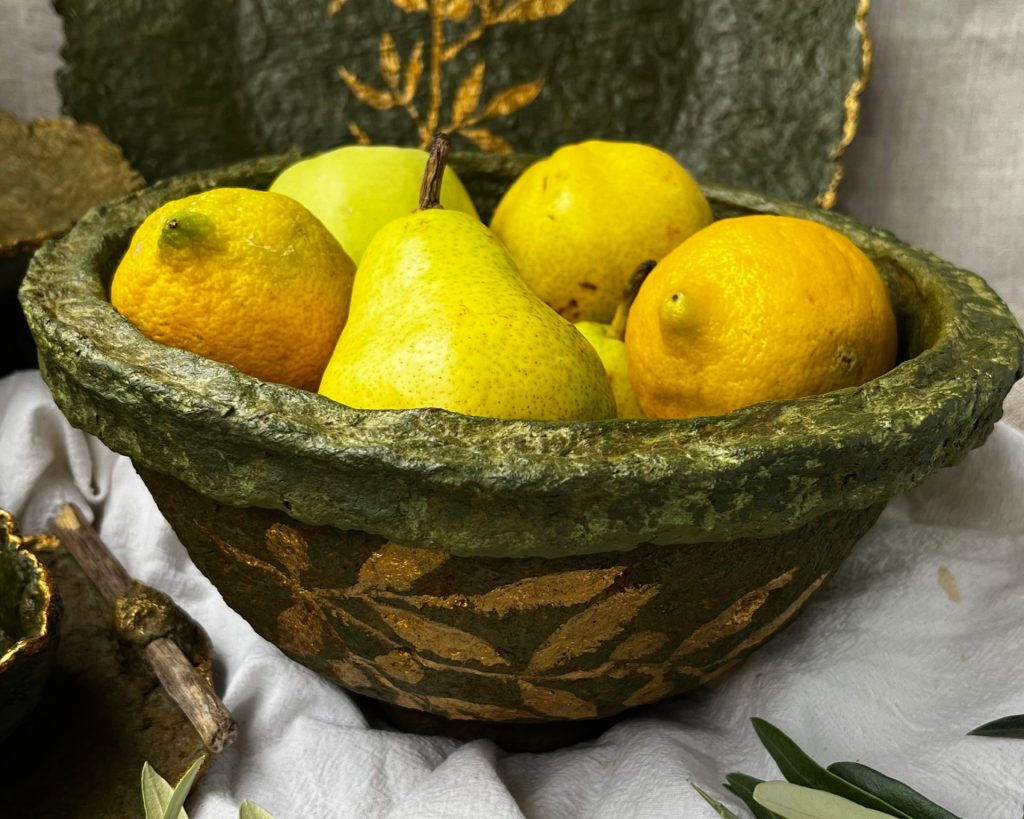
The production process depends on several factors – the size of the piece, the thickness of the layers, and drying conditions – so smaller objects can be completed in a few days, while more complex works may require several weeks. Paper pulp is highly suitable for shaping and allows for the creation of a wide range of objects – from decorative bowls, plates, and vases to wall decorations and sculptural forms.
However, as with every handmade object, it is important to know its limits. These works are intended primarily for decorative use – although paper pulp can be very strong, it does not favor prolonged contact with water or direct exposure to sunlight. Their longevity does not come from resistance to all conditions, but from the care with which they are preserved: it is enough to remove dust and treat them with a little attention occasionally. Over time, they can also be refreshed with a new layer of paint and adapted to a different space or taste.
She finds inspiration for her designs in nature, interesting textures, and the shapes that surround her, as well as on the internet. However, the final appearance of a piece is rarely known in advance — it most often develops spontaneously and freely through the very process of creation, which, as she points out, is what she enjoys the most.
Most of her works are created from personal inspiration and are only later found by their owner. When it comes to clients’ wishes, she tries to incorporate them into her own way of working, noting that with handmade work, it is difficult to achieve complete uniformity.
As with every artist, it is important to her that her objects captivate people at first glance – not only because of their appearance, but also because of the story they carry. It is especially meaningful to her when people recognize the effort, time, and attention woven into her works, as well as the moment when they are surprised to learn they are made of paper. She adds that many people have prejudices about this material, but are often surprised by its strength and possibilities.
– If, after that, they start looking differently at the materials we discard every day, I believe my work has fulfilled its purpose. And if I inspire someone to start creating, experimenting, or giving new life to old materials themselves, I see that as the greatest compliment and the most beautiful confirmation that what I do makes sense, says Mariana.
All the paper she uses comes from her household – paper that has already been used, and often there is more of it than she can process. As she says, this is also a reminder of how much waste is generated in our homes each day. Through her work, Mariana wants to show that creativity and sustainability can go hand in hand, and that beauty is often hidden precisely in the things we would otherwise throw away.
Prepared by Katarina Vuinac
The story was published in Energy portal Magazine CLEAN ENERGY