

Newsletter Subscribe
Enter your email address below and subscribe to our newsletter

Natural materials are becoming increasingly important in replacing fossil fuel–based insulation products and enabling sustainable solutions for more energy-efficient buildings. The current year has proven to be particularly fruitful in the field of sustainable architecture, and early autumn brought news of two significant discoveries in the area of construction materials.
The first is a mushroom-based insulation material that is currently being tested for its flexibility, moisture resistance, and thermal conductivity. The second is a building material that combines cardboard, water, and soil.
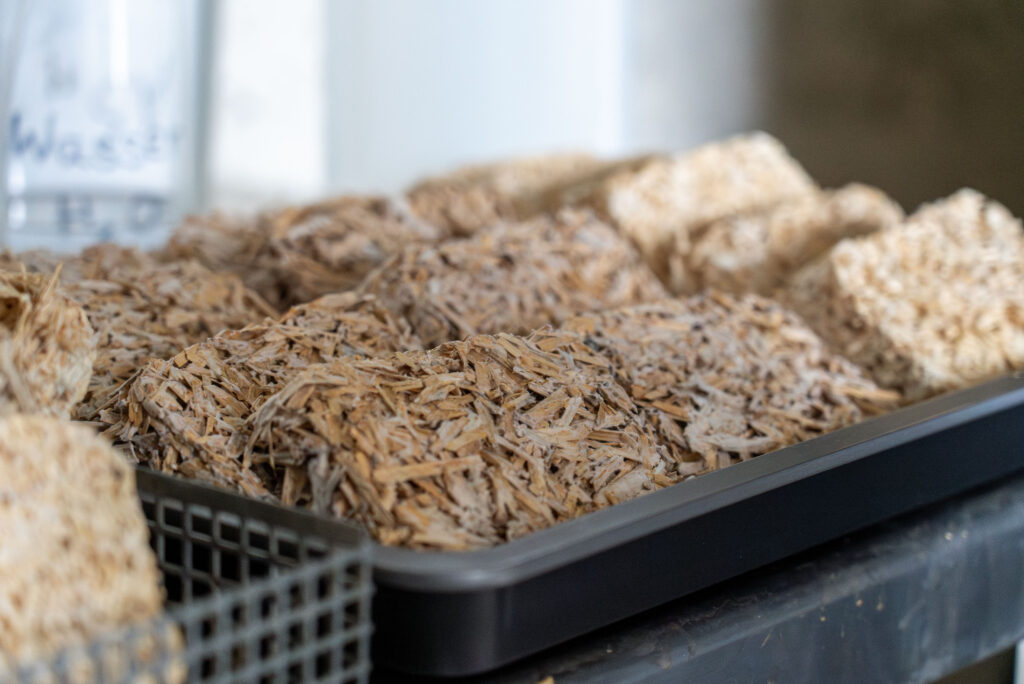
Researchers at the Hof University of Applied Sciences in Germany have developed an innovative insulation material made from fungal mycelium (the root structure of fungi), while their industrial partner, Johann Bergmann GmbH & Co. KG, is testing the possibilities for large-scale production. The Mycobuild Project has a long-term goal of transferring research results into industrial applications. Insulation made from fungal networks could offer significant environmental and economic benefits. The project aims to demonstrate industrial feasibility by March 2026 and contribute to the development of environmentally friendly construction methods for the future.
Mycelium grows on a substrate made from local agricultural residues such as straw, binding the material into a compact mass before being dried and heated to deactivate the fungus. The primary challenge lies in maintaining sterile conditions, as even minor contamination can render the entire culture unusable.
“Fungal networks offer numerous advantages: they are compostable, store CO2, and require less energy to produce than conventional insulation materials. They can be flexibly shaped and scaled up for industrial production,” said Professor Robert Honke.
Domestic fungal species — such as oyster mushrooms, honey mushrooms, porcini, and giant puffballs — have proven particularly promising. They grow at room temperature without the need for additional heating or cooling, making production highly energy efficient. The oyster mushroom stands out as the most resilient, spreading rapidly and forming dense networks. However, cultivation carries risks, as competing microorganisms can destroy the entire growth cycle. For this reason, developing a protective mineral coating plays a crucial role; once full moisture resistance is achieved, the material could exhibit the same or even superior properties compared to traditional insulation.
A material known as cardboard-reinforced rammed earth consists solely of cardboard, water, and soil, and is fully reusable and recyclable. It was developed in Australia, where more than 2.2 million tons of cardboard and paper are sent to landfills each year, while cement and concrete production accounts for around eight percent of global annual CO2 emissions.
A research team from RMIT University claims that this new building material has a carbon footprint four times lower than that of concrete — and in this case, it is completely eliminated.
Walls made from cardboard, soil, and water are strong enough to support low-rise structures, while being significantly cheaper and more climate-friendly than concrete. One of the advantages of this material is that it can be produced directly on-site. Massive rammed-earth walls naturally regulate temperature and humidity, reducing the need for air conditioning and lowering emissions further.
“This innovation could revolutionize the way we design and construct buildings, using locally available materials that are easier to recycle. It also reflects a global return to earth-based construction, driven by net-zero emission goals and a growing interest in sustainable local materials,” said Professor Zhijing Ma from RMIT University.
Researchers have developed a formula that allows the calculation of wall strength based on the thickness of the cardboard forms. In parallel studies, they also demonstrated that combining rammed earth with carbon fibers can achieve strength comparable to that of high-quality concrete.
The authors emphasize that this innovation could become a key to greener and more affordable construction — particularly in regions abundant with soil suitable for such technology.
Prepared by Jasna Dragojević
The story was published in Energy portal Magazine GREEN ARCHITECTURE