Photo: NASA/JPL-Caltech/Keith Miller (Caltech/IPAC)
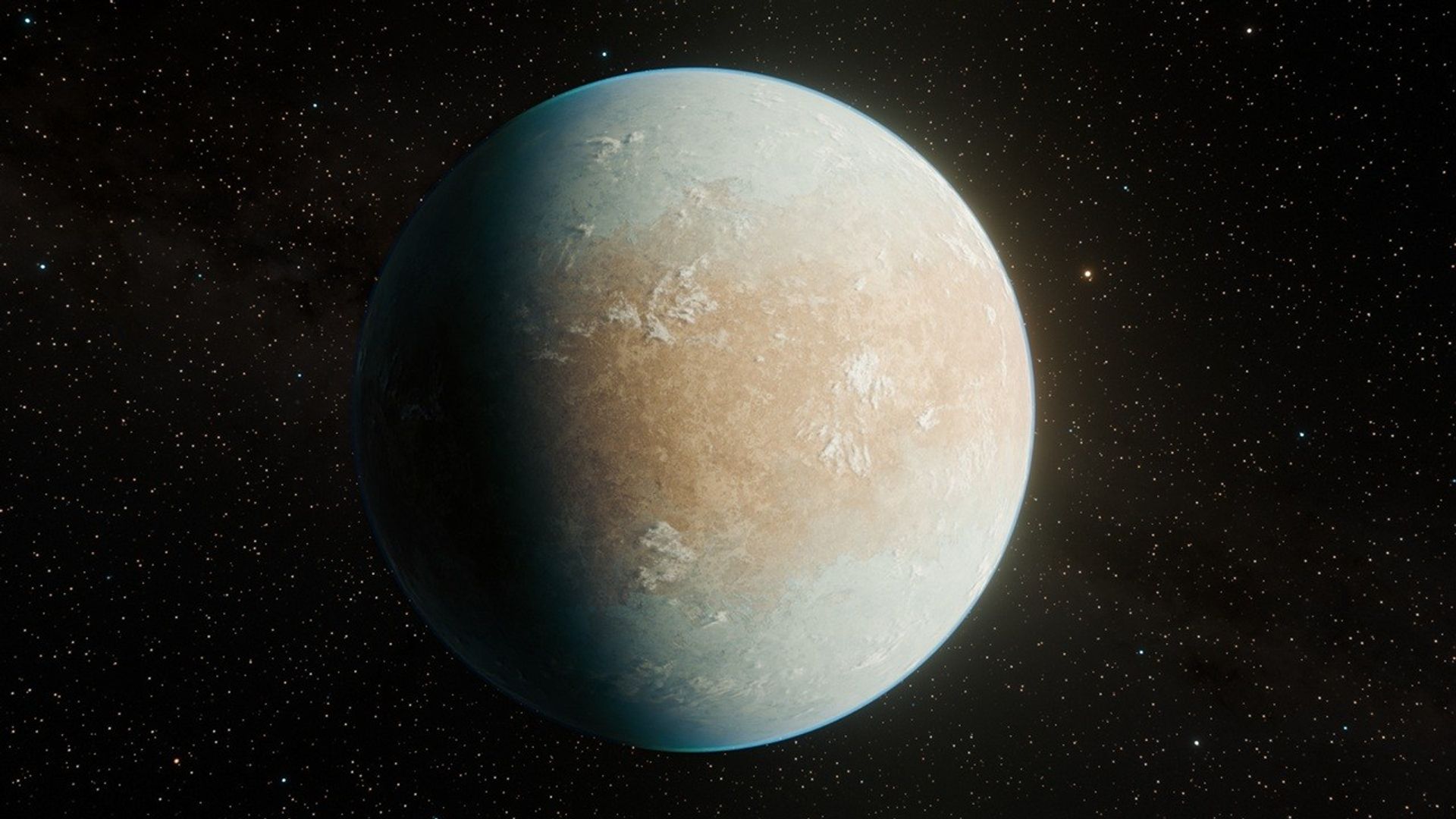
NASA has just added another entry to the long list of potentially “Earth-like” worlds. HD 137010 b is the name of a rocky planet, only slightly larger than Earth, orbiting a Sun-like star about 146 light-years away. Its year lasts roughly as long as ours, and its orbit lies near the outer edge of its star’s so-called habitable zone—meaning that, at least in theory, liquid water could exist there.
By current estimates, HD 137010 b receives less energy from its star than Earth gets from the Sun, and its host star—while broadly similar to our Sun—is cooler and dimmer. The result? The planet’s estimated surface temperature could be around −68°C, colder even than Mars.
So are we being overly romantic when we talk about a “second Earth”?
Here’s where the story gets most interesting: scientists suggest that this planet, despite its icy conditions, may not be a lost cause. If it had a denser atmosphere rich in carbon dioxide, a greenhouse effect could significantly raise temperatures. In that scenario, HD 137010 b could even have a temperate climate—or represent some form of water world.
The models used by the authors give it about a 40 percent chance of falling within the “conservative” habitable zone, and a 51 percent chance of landing in the broader, “optimistic” zone. In other words, its odds are close to fifty-fifty—and in astronomy, that is far from insignificant.
Foto-ilustracija: Unsplash (Adam Miller)
What adds another layer of fascination is how the planet was detected. The entire finding is based on just a single transit—the moment the planet passed in front of its star and cast a tiny shadow recorded by the Kepler telescope during its K2 mission.
Kepler’s mission, which officially ended in 2018, observed more than 500,000 stars over its lifetime, patiently registering the moments when planets crossed in front of them. During such transits, a planet blocks a minuscule fraction of starlight, seen from Earth as a nearly imperceptible dip in brightness. That subtle change allows astronomers to identify a planet’s presence and estimate its size and orbital characteristics.
From a single transit of HD 137010 b, researchers were able to infer its orbital period, planetary size, and distance from its star. Impressive—but also frustrating. Scientists note that capturing more transits will be difficult: because the planet’s orbital distance is so similar to Earth’s, these events occur much less frequently than for planets in tighter orbits. This is also the main reason why exoplanets with Earth-like orbital periods are so hard to detect in the first place.
And as we wait for new data on this cold planet—and for a new generation of space telescopes that can deliver sharper insights—it may be the right moment to rethink what we mean by “Earth-like” worlds.
HD 137010 b does not fit neatly into our favorite narratives of blue planets, mild temperatures, and familiar life. Instead, it reminds us that similarity to Earth is not a matter of comfort, but of physics, chemistry, and long cosmic trade-offs.
If life exists somewhere else, it may well be evolving at the edges of what we are willing to consider acceptable—in conditions we would call extreme, yet which may be entirely rational in a cosmic context.