




Newsletter Subscribe
Enter your email address below and subscribe to our newsletter


Plastic waste has become one of the greatest environmental challenges of the modern era. Enormous quantities of plastic end up in landfills, where it takes hundreds of years to decompose, releasing harmful chemicals into soil and water, threatening wildlife, and entering the human food chain in the form of microplastics. Developed countries devote significant attention to this issue and operate modern sorting and recycling centers, enabling the majority of waste to be reused.
That the region can also serve as a role model in this field is demonstrated by an innovation from Banja Luka, where a solar-powered recycling container has been designed and developed within the Center for Mechatronics and Technical Sciences.
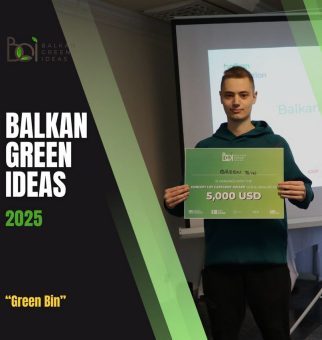
The innovation, named Green Bin, has already traveled across the region. At the international Balkan Green Ideas competition held in Ohrid in November, it won first place for Bosnia and Herzegovina and was selected as one of the four best ideas among six Western Balkan countries. It was also presented at the threeday startup camp CampUP 2025 in Banja Luka, where it likewise won first place. The project is expected to be presented at the Innovation Competition Serbia, and results are also awaited from the Regional Butterfly Innovation Award competition.
Marko Glišić, a mechatronics student at the University of Banja Luka and President of the Center for Mechatronics and Technical Sciences, told Energy Portal Magazine that the prototype of this container has been under development for around six months.
“My mother, who works as a project manager, suggested launching a youth-oriented initiative in front of the Center for Mechatronics and Technical Sciences, implemented by the KULT Institute in cooperation with the EU, to highlight the growing problem of plastic waste and offer a practical solution. My father, an electrical power engineer by profession, proposed a recycling container that would shred plastic bottles on-site, thereby significantly reducing waste volume and logistics costs.
Through further development of the idea, the recycling container was equipped with a solar panel, making it independent of existing infrastructure and providing an environmentally friendly way to power the shredding mechanism, as it uses renewable energy sources,” Glišić explains.
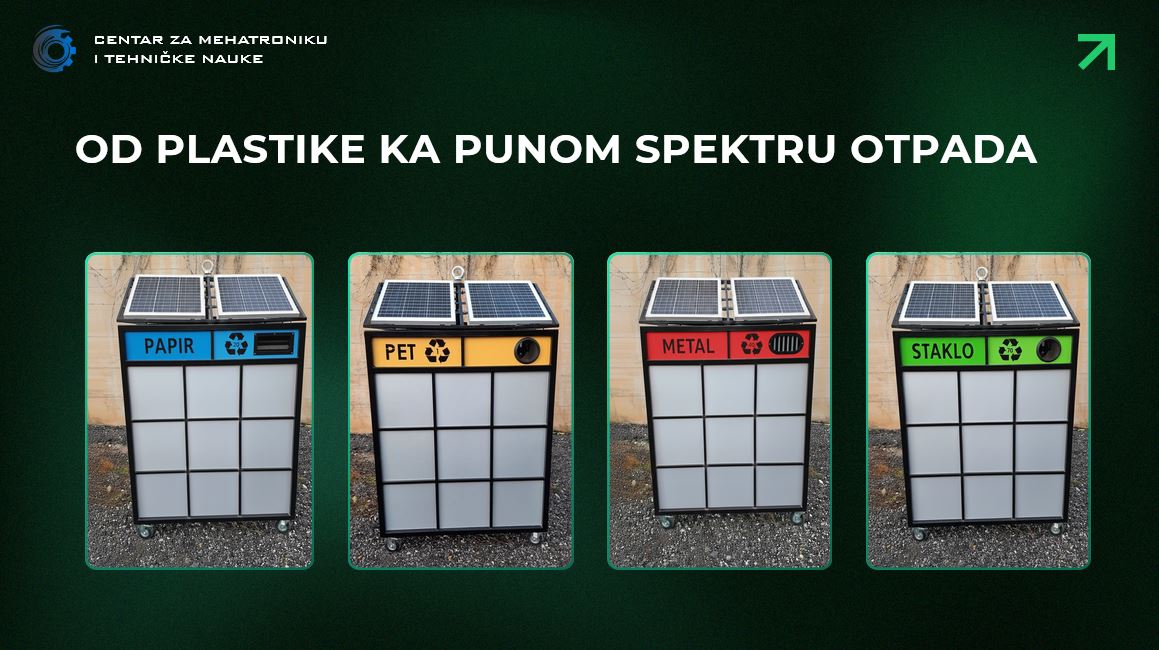
The container structure is made of steel tubes measuring 40 × 40 mm and 20 × 20 mm, clad in composite aluminum panels. The lower section also serves as the waste discharge opening and as a chamber for injecting argon gas.
The lid also functions as a mounting structure for the solar panels and can be rotated to ensure optimal solar energy capture.
Emptying is carried out either by lifting the container using the lifting hook or via side bars, in the same way as a conventional waste container. The shredding mechanism and the battery for electrical energy storage are mounted and securely fixed inside the structure.
Green Bin operates fully autonomously thanks to its solar power supply.
– Users insert plastic bottles, which are then shredded, reducing the volume of waste several times over. This decreases the frequency of waste collection and lowers the operating costs for municipal utility companies, while the collected material can be further processed for recycling. Unpleasant odors from residual liquids in the bottles would be neutralized by injecting argon gas into the waste chamber. As argon is heavier than oxygen, it would inhibit further processes within the bottle contents, while unpleasant odors would remain trapped inside the argon-filled chamber. When inserting bottles into the shredding opening, users would not experience any unpleasant smells, explains Glišić.
In addition to reducing the costs associated with bulky plastic waste, the use of such containers promotes the circular economy and encourages compliance with European environmental protection and sustainable development standards.
The Green Bin project was first recognized and supported by the Institute for Youth KULT from Sarajevo. Through this initiative, cooperation was established with the Secondary Technical School in Banja Luka, which expressed interest and provided space for installing the recycling container, planned for the end of December.
This invention is currently in the patenting process, with plans to expand the concept in the near future to address wastepaper, glass, and metal. Glišić expects that promoting the project at fairs and competitions will also attract potential investors.
Prepared by Jasna Dragojević
The story was published in Energy portal Magazine RESPONSIBLE BUSINNES