Newsletter Subscribe
Enter your email address below and subscribe to our newsletter


Behind great scientific achievements, the spark of an idea has often been born in nature. Sometimes it is a gaze into the sky, sometimes the flight of a bird, the movement of water, or the glow of insects on a summer evening. In stories and local museum exhibitions dedicated to Mileva Marić, for example, it is noted that the dance of fireflies above the Tisa River near Titel was associated with her reflections on light, matter, and energy. There are truly countless examples that confirm how often nature has awakened scientific curiosity.
From many observations of nature, ideas emerged, and later the very concept of biomimicry — an approach in which humans do not seek to conquer nature but to understand it and adopt principles and concepts from it that have proven successful over time.
Aircraft are not creations of nature, but they have borrowed a great deal from it, above all when it comes to aerodynamic logic. The wings of birds, which have used air currents for centuries better than any human-made machine, served as inspiration. A similar thing happened with whales. The bumps on the leading edge of the fins of humpback whales, which at first glance appear to be imperfections, proved to be a mechanism for moving through water. It was precisely these shapes that inspired engineers to think differently about wind turbine blades and about how wind energy can be used with fewer losses.
One of the best-known examples of biomimicry in architecture is linked to termite mounds. In hot regions, biologists discovered that termites can maintain more stable internal conditions within their shelters despite large temperature differences outside. This principle did not inspire architects to construct buildings that look like termite mounds, but rather to try to discover what termites know that humans perhaps still do not know well enough. The Eastgate Center in Harare, Zimbabwe, is often cited as an example of this approach and system, as the building uses air channeling, the thermal mass of materials, and natural heat dissipation to reduce the need for conventional cooling.
The hummingbird, a bird capable of hovering in place, changing direction abruptly, and controlling the movements of its wings with exceptional precision, has, according to many accounts, inspired scientists and engineers in the development of small flying robots and drones.
In all these examples, the same idea is repeated: long before humans, nature had been finding ways to solve problems of movement, cooling, ventilation, protection, water collection, and the use of sunlight. Moreover, its solutions rarely have only one function. A termite mound is not merely a shelter, but also a natural ventilation system. A tree is not merely a plant, but also shade, a water reservoir, a habitat, and a collector of solar energy.
It is precisely from this way of thinking that a question arises: can solar trees also be viewed as a contemporary attempt by technology to take over some of the functions of a real tree?
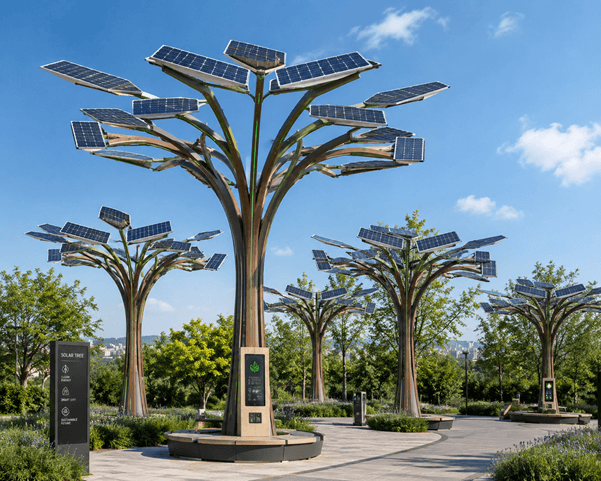
Some solar trees have gone a step further — they are not only collectors of sunlight through solar panels, but also small-scale urban infrastructure capable of generating electricity, providing shade, collecting rainwater, powering lighting, charging devices, and becoming part of the public life of a city.
At first glance, solar trees look like a scene from a futuristic vision of the future: a metal trunk, a branched canopy, and solar panels instead of leaves. Just as a real tree spreads its branches to capture as much sunlight as possible, a solar tree arranges photovoltaic panels at different heights and at different angles.
This is why they most often appear in places where space is limited, while the need for energy, shade, and urban equipment is increasing — in parks, squares, parking lots, promenades, and in front of public buildings. Unlike conventional solar power plants, which require large areas, solar trees use height and fit into spaces that people already use every day. It is therefore no surprise that they are particularly recognizable in Asia, where large cities are densely populated, and every square meter is carefully planned.
Of course, this does not mean that they can replace conventional panels when the goal is large-scale electricity generation. Their advantage is different — they bring energy into the everyday lives of residents and into spaces where conventional panels are often impractical or not visible enough.
Depending on their size and the number of modules, larger installations can generate tens of thousands of kilowatt-hours per year, thereby avoiding several tons of carbon dioxide emissions. This energy is most often used locally — for public lighting, chargers, sensors, Wi-Fi equipment, electric bicycles, or smaller vehicle charging stations. At the base of the tree, there is often a small energy center with batteries, inverters, and connection points, enabling electricity to be used immediately or stored for later use. In simpler models, the panels are fixed in different positions, whereas more advanced solutions track the movement of the Sun.
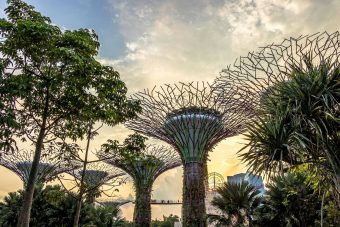
The most developed example of this way of thinking can be found in Singapore, in the Gardens by the Bay complex, which features a total of 18 Supertrees, 11 of which have built-in sustainable functions. The trees range from 25 to 50 meters in height, but their role is not merely to attract tourists, although they have become globally recognizable for that as well. They are part of a much more complex system in which energy, water, plants, cooling, and public space are connected into a single whole.
These trees are covered with thousands of plants — orchids, ferns, bromeliads, and climbers — and therefore function as vertical gardens in one of the most densely populated urban environments in the world. Some of the trees have integrated photovoltaic cells that generate electricity for part of the lighting and systems within the complex.
The Supertrees also collect rainwater, which is then used to irrigate the gardens and supply water features. In a tropical climate, where rainfall is abundant, water is not treated as an excess that should be channeled away as quickly as possible, but as a resource that should be retained, directed, and reused.
Even more interesting is their connection with the huge Flower Dome and Cloud Forest conservatories, which maintain special climatic conditions different from Singapore’s humid outdoor climate and therefore require complex cooling and ventilation systems. The Supertrees also participate in this part of the system — they assist in air exchange and heat dissipation, acting as a kind of urban lung of the complex.
This is why Singapore has gone far beyond the idea of simply placing solar panels in the shape of a tree. There, the solar tree is part of an entire urban ecosystem. Its greatest value lies not only in the amount of electricity it produces but also in its ability to serve simultaneously as infrastructure, a garden, shade, a reservoir, a ventilation element, and a city landmark.
Prepared by Milica Vučković
The story was published in Energy portal Magazine CLEAN ENERGY