

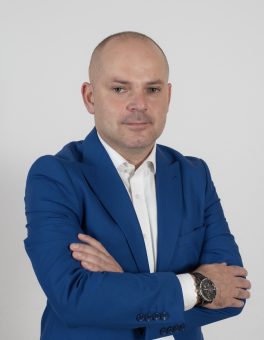
The Environmental Protection Fund of the Republic of Srpska plays an important role in financing and promoting projects that contribute to nature protection and the improvement of environmental standards. Through various funding programs, the Fund supports local communities, businesses, and public institutions in implementing measures that foster sustainable development and a higher quality of life. To discuss the projects currently being implemented by the Fund, its plans to support local communities and the private sector in the coming year, as well as other plans for 2026, we spoke with Denis Stevanović, Director of the Fund.
Q: How would you assess the Fund’s work to date in improving energy efficiency and environmental protection in the Republic of Srpska?
A: I believe that the work of the Environmental Protection and Energy Efficiency Fund of the Republic of Srpska in the previous period has been truly successful, as we have implemented a wide range of projects across the Republic of Srpska. The Fund has co-financed projects primarily for public utility companies in the field of environmental protection, focusing on strengthening their capacities. At the same time, local governments have been our constant partners, and we have co-financed numerous projects at the municipal level.
On the other hand, a certain level of support was also provided to the business sector and private individuals. In cooperation with UNDP and the EBRD, we have rehabilitated facilities and implemented energy-efficiency measures across a large number of buildings in the Republic of Srpska—primarily schools, kindergartens, and public healthcare facilities. Overall, I believe that the Fund has proven itself to be a significant institution of the Government of the Republic of Srpska, that it has justified its role, and that the results of our work are clearly measurable.
IN FOCUS:
- Paper Magic: When Creativity Brings Old Books to Life
- Brazil Between the Challenges and Opportunities of the Green Transition
- The Green Transition Cannot Be Put on Hold – Erste Bank Launches a Pioneering ESG Model in Serbia
Q: What are the key projects the Fund has implemented in the recent period?
A: In addition to supporting public utility companies, local governments, private individuals, and the business sector, in the recent period, we have established a system for the management of packaging waste. As a result, we no longer face packaging waste issues across the territory of the Republic of Srpska. This was achieved, of course, through the co-financing of projects—again primarily involving public utility companies— and through the introduction of so-called operators into the system, which I would highlight as a particularly significant achievement.
Q: Do you plan to introduce new support programs for municipalities, public institutions, or the private sector?
A: As regards the coming year, the Fund will continue its regular activities. We will co-finance projects in the fields of environmental protection and energy efficiency through our public calls, as well as through decisions of the Director and decisions of the Government of the Republic of Srpska. One new initiative I can announce is that next year, we plan to address the situation on the ground regarding end-of-life vehicle tires. This is one of the specific waste categories, and we plan to launch a public call for an operator that will collect and properly manage all tires currently present across the Republic of Srpska, which is highly important for environmental protection.
In addition, we will maintain a permanent public call in the areas of environmental protection and energy efficiency aimed at sole proprietors, associations, local governments, and others, as well as a major call for environmental protection projects co-financed with public utility companies and local authorities—such as the procurement of municipal equipment, improvements in drinking water supply capacities, and similar activities. One such public call has recently been completed, and we expect the results and the allocation of funds shortly. We also have an ongoing call targeting micro, small, and medium-sized enterprises for energy efficiency measures. These are some of the calls we will most likely continue to implement next year as well.
Q: When can citizens expect subsidies for solar power plants and energy-efficient renovation of homes?
A: In 2023 and 2024, we launched public calls under the so-called European Union Energy Support Package for the Western Balkans, as a form of assistance to households during the energy crisis caused by the war in Ukraine. At that time, private individuals were able to apply for grants of up to BAM 5,000 if they implemented certain energy efficiency measures in their houses or apartments. These measures included façade thermal insulation, heating system improvements, the installation of solar panels on residential buildings, roof and ceiling renovation, and similar works.
We did not launch such a call in 2025, as the European Commission program had ended, and the Fund did not have the capacity to support citizens at that scale using its own resources. However, we are striving to identify solutions for next year, as this public call proved to be very attractive and of great interest. We want to support citizens and ensure that everyone can benefit from our work. One possible approach could be through revolving financing schemes with banks or similar mechanisms, since it is not realistic for the Fund to co-finance all households wishing to insulate façades, replace windows, or carry out other home improvements solely from its own funds.
Interview by Jasna Dragojević
The interview was published in Energy portal Magazine RESPONSIBLE BUSINNES
