


High in the stark Nevada desert, a couple of hundred miles north-west of Las Vegas, is the shimmering circular mirage of Crescent Dunes. Ten thousand silvery glass panels, each measuring 115 square metres, surround a tall central tower, which stands like a twinkling needle in the featureless landscape around it. Resembling a fabulous alien metropolis, Crescent Dunes is in fact a highly sophisticated, mile-and-a-half-wide solar power plant – “the next generation in solar energy”, according to Kevin Smith, one of the project’s founders.
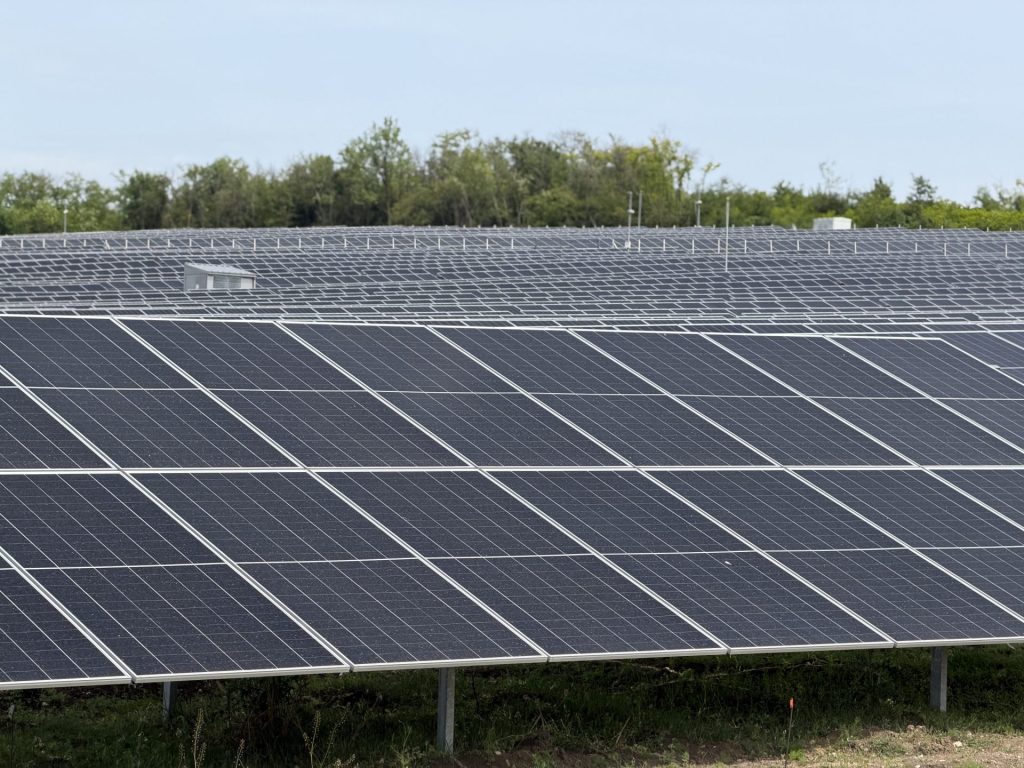
The glass panels, which comprise a combined area of more than a million square metres, are not photovoltaic (PV) panels like those installed on rooftops and in solar farms worldwide. Instead, they are simply vast, multifaceted mirrors, which track the course of the sun like heliotropic plants. This field of mirrors harnesses and concentrates the blazing Nevada sunshine, directing it precisely towards the top of the central tower.
“The difficulty with photovoltaic is that it’s intermittent,” says Smith, who is CEO of Crescent Dunes’s parent company, SolarReserve. “When the sun goes down, you’re done.” Engineers have long sought methods of storing solar energy – in water, in batteries, in fluid-filled “parabolic troughs” – but Smith claims that Crescent Dunes demonstrates “the world’s most advanced energy-storage technology”, known as molten-salt storage.
The central tower secretes a reservoir of potassium and sodium nitrate – about 25,000 metric tonnes of it – heated in advance to 288°C, at which temperature the mixture is a clear, water-like liquid. This is circulated in narrow, thin-walled tubes, rising dramatically in temperature when exposed to the fearsome, concentrated sunlight at the top of the tower. “We heat it to 560°C,” says Smith, “it flows back down the tower and we capture it in a large tank.”
The molten salt efficiently maintains the heat and when the energy is required, it is converted to electricity through a conventional steam turbine. This set-up allows Crescent Dunes to provide power to 75,000 Nevada homes long after the sun has set and even, if necessary, 24 hours a day. Smith believes that concentrated solar power (CSP) is not simply a substitute for photovoltaic panels but a potential competitor to conventional fuels. “It’s really an alternative to fossil fuel or even nuclear. You couldn’t power a city with just PV and wind, but you could with CSP, because of the storage capacity.” SolarReserve is already developing cheaper, higher-capacity installations and planning to build similar solar plants in South Africa, Chile and China.
Of course, the technology isn’t flawless: CSP can only efficiently operate in areas with intense, uninterrupted sunlight and birds can be burned and killed by the concentrated sunbeams. Nonetheless, Crescent Dunes emits no pollutants, uses a fraction of the water required to generate coal or nuclear power and occupies a smaller combined area than, say, a coal-fired power station. Assuming the technology proves sustainable and replicable, among the ancient mountains of the American west, a bright future may be under way.
Source: theguardian.com


One-third of Europe’s countryside is potentially affected by noise pollution caused by human activity, according to a new report published in June by the European Environment Agency (EEA). Protecting areas not yet affected by noise can bring significant environmental and health benefits, the report says.


According to Balkan Energy News, team of designers and entrepreneurs based in Belgrade is working on solutions to reduce the car industry’s share in greenhouse gas emissions. Saša Milovančević, one of the founders and chief executive of Aqos Technologies d.o.o., said a solar film which the startup developed allows for the creation of thematic solar-conventional vehicles which won’t have an issue with aesthetics regarding solar cells. The texture and appearance of the cells are an indigenous art motif that should give a new visual – distinctive character to the car, he added. The solar cell has flexibility with two axes and Aqos is working on the solution for all three axes, with increased efficiency in all lighting conditions.


The Spanish Wind Energy Association (AEE) awarded Dr Fatih Birol, the IEA’s Executive Director, its Annual Distinction in recognition of the IEA’s work in promoting renewable energy in Spain and across Europe. In a statement announcing the award, the AEE recognized efforts by the IEA and Dr Birol at highlighting the fact that renewable are no longer a niche and should now be considered a conventional source of energy.