

The integration of the European Union’s energy market and the Energy Community is no longer only a political objective, but a shared economic, climate and security imperative—this is the key conclusion of the Energy Community Secretariat’s 2025 Implementation Report. The document highlights tangible progress by the Contracting Parties in aligning with EU energy and climate legislation, further strengthening their role as reliable partners within a unified European energy space.
As Europe’s energy landscape rapidly evolves and markets adjust to ambitious climate goals, reforms within the Energy Community are becoming crucial for more competitive markets, greater clean-energy investments and more secure supply. Additional pressure comes from the Carbon Border Adjustment Mechanism (CBAM), which will begin applying to electricity trade as of 1 January 2026.
Progress in adopting EU rules: Serbia and Moldova as frontrunners
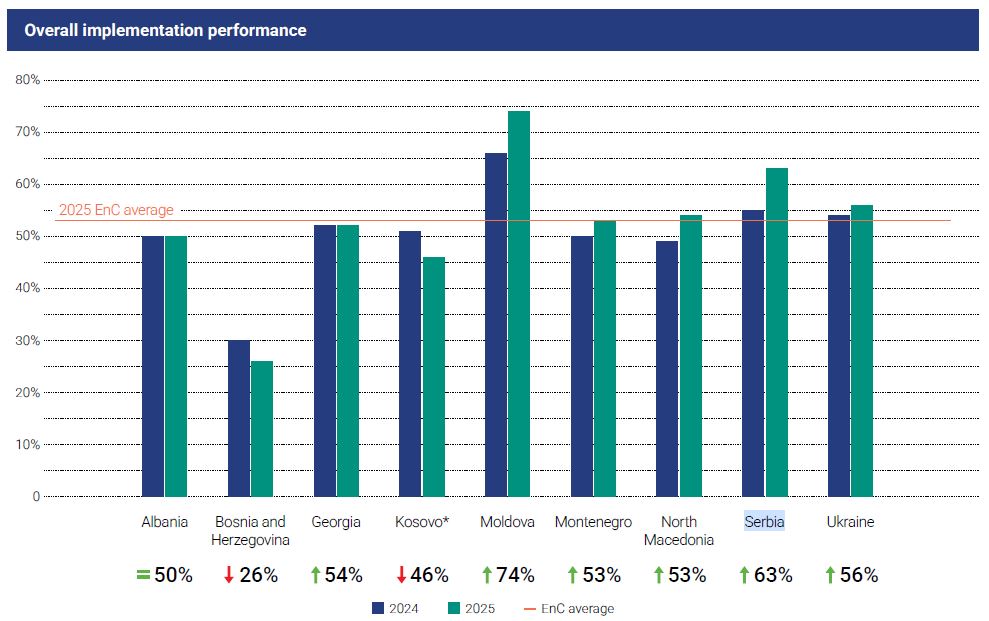
Three years after the adoption of the Electricity Integration Package (EIP), the efforts to transpose its legal acts have yielded the first significant results. Although most Contracting Parties failed to adopt all nine mandatory acts by the deadline of 31 December 2023, Serbia and Moldova demonstrated that full adoption is achievable.
Following the adoption of the new Energy Law at the end of 2024, Serbia continued implementing network codes and guidelines, completing the process in August 2025. Moldova, meanwhile, adopted all remaining network codes, thereby also completing the EIP. Montenegro and North Macedonia progressed by adopting new energy laws, while draft laws prepared in Bosnia and Herzegovina and Ukraine are still awaiting parliamentary procedure. Albania, Georgia and Kosovo* have yet to move beyond drafting legislation.
Electricity market integration – key to decarbonisation and CBAM exemption
The report underscores that continued decarbonization will directly depend on progress in electricity market integration, which is expected to unlock much larger trading volumes and investment potential than what small national markets can provide. Full adoption of the EIP is a prerequisite for market coupling with the EU before accession—and for exemption from the application of CBAM on electricity trade.
Given the current pace and the necessary compliance checks by the European Commission, the earliest possible market coupling can be expected in 2028.
Gas sector: accelerate reforms and strengthen cross-border flows
The European gas market is entering a new phase in which deeper integration with the Energy Community is essential for energy security after the gradual phase-out of Russian gas. EU Member States are expected to apply network codes at all borders from August 2026, requiring consistent cross-border coordination with the Contracting Parties.
The report notes progress in gas-sector reform in Serbia, Moldova and North Macedonia, but stresses the need for more even advancement across the region. It particularly highlights the importance of making cross-border capacities more efficiently available—especially on routes such as the Trans-Balkan Gas Pipeline, a key corridor for diversification and competition.
The Secretariat’s annual Implementation Report monitors how Contracting Parties are fulfilling their obligations under the EU energy and climate acquis, assessing compliance and overall progress. As the European energy market continues to transform rapidly, the Energy Community emphasises that faster integration is both necessary and achievable.
Energy Portal
*This designation is without prejudice to positions on status, and is in line with United Nations Security Council Resolution 1244 and the opinion of the International Court of Justice on the declaration of independence of Kosovo.
